Chapter 1
The room smelled like fresh latex paint laid over something much older, the way a new air freshener in a car doesn't fool anybody about the dog.
Mitchell Brown stood in the doorway of North Dormitory with his duffel over one shoulder and counted. Door to the stairwell, door to the washroom, this door, the two down the hall he'd passed on the way up. Five. He didn't decide to count them. It happened the way other people crack their knuckles.
His half of the room had a bed, a desk, a window with a screen gone the color of weak tea, and a wall where new plaster stopped and old stone kept going. The stone had a shine to it in the corners, a hard gray shine like the inside of a sink. Somebody had bolted a laminated card by the light switch: WELCOME TO HALCYON. SIX WEEKS. WORK HARD. It was already peeling at the top corner, and Mitchell had a strong urge to press it back down.
Twenty minutes later, his roommate arrived dragging a mended backpack and a garbage bag of bedding.
"Brian," the kid said. "Payne. Like the thing that hurts." The joke fell dead, as it clearly had before. "Sorry. That's — people say it first, so I say it first."
"Mitchell." He put his hand out and Brian shook it like they were signing something. "You can have the window if you want it. I'm not attached."
"The window." Brian looked at the window, and then at the beds, and then at the window again. "Are you sure? Because I don't want to — "
"I'm sure."
Brian's hoodie was two sizes too big and gray as dishwater, and he pushed the sleeve over his palm before he touched the door handle to close it. Not a flinch, exactly. More like a rule he'd been following so long he didn't know he had it.
Mitchell went back to unpacking by system: clothes in the bottom two drawers, books stacked by size on the desk, and the flat manila envelope from the Halcyon Foundation buried beneath everything, where he wouldn't have to see his name beside the word AWARDED. The envelope had ridden all the way from Beaver Falls on his lap. His mother had put a rubber band around it, which was her version of a blessing.
Behind him, the bedframe screeched.
"It's off the wall," Brian said. "The head of it. It's out about — " he crouched, squinting into the gap, "there's a whole thing back here. There's a pipe."
"You want a hand?"
"No, no. I've got it. I've got it."
Mitchell was folding a T-shirt when he heard the second screech, shorter, and then a sound that wasn't the frame at all. It was the small wet intake of breath a person makes when their body has understood something a half second before they do.
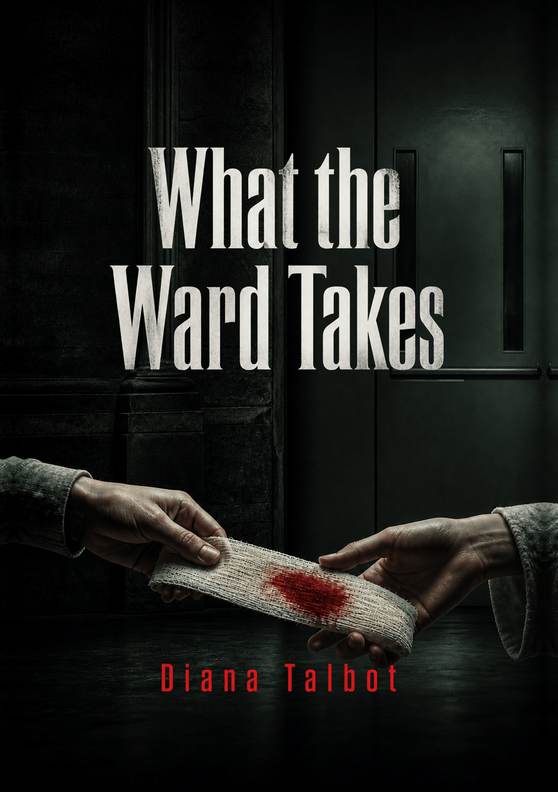
Brian was on his knees with his right hand held up in front of his face, palm out, like he was being sworn in. The blood came up through the crease of it fast, filled the lines, and started dropping. Three drops on the floorboards, then a fourth. The boards were old and thirsty and the drops soaked in and went brown at the edges immediately.
"Okay," Brian said. "Okay. That's — okay."
"Don't close it." Mitchell was already moving. "Keep it open, keep it up. Higher than your heart."
Down in the gap behind the bedframe, where the plaster had been cut back for the renovation, a strip of copper stood proud of the wall, bright and newly exposed and shaved at the top edge where somebody's tin snips had left it. Not a nail. Not a spring. A clean bright ribbon of metal with about a fingernail's worth of Brian's palm still on it.
The Blue First-Aid Tin was in Mitchell's duffel, third thing down, because it was always the third thing down. Blue enamel with a white cross gone gray in the middle from thumbs. It had been his grandmother's sewing tin before it was anything else, and it still had a faint smell of old thread under the alcohol wipes.
He got it and came back and knelt on the boards, and Brian held the hand out toward him.
Later, in the infirmary and through the rest of that summer, Mitchell would return to this part: Brian held it out. He didn't have to be asked.
"That's going to need a rinse," Mitchell said. "Copper's dirty, and that one's got a burr on it. You want to know what I'm doing or you want me to just do it?"
"You can tell me." Brian's voice had gone thin and polite. "I'd rather know. I don't like when people don't say."
"Fine. Three things." He set the tin on the floor between them and thumbed it open. "One, I flush it out, and that's going to sting worse than the cut did, and it's supposed to. Two, I put a pad on it and press, and I press harder than you'll like, for longer than you'll like. Three, I tape it up. Then you leave it alone and it's boring by Thursday."
"Boring by Thursday." Brian let out a breath that was almost a laugh. "Okay."
He put his hand into Mitchell's.
It was a cold hand for a warm night. Mitchell held it steady, fingers under Brian's wrist and thumb along the base of his thumb, and worked over the wastebasket with the saline. The cut ran diagonal across the meat of the palm, from below the index finger down toward the wrist, and it wasn't deep enough for anything dramatic, but it was long, and long cuts on hands bleed like a bad plumbing joke. Brian's whole arm went rigid at the flush, but he held still. He was practiced at holding still. Mitchell filed that away without yet knowing why.
"Talk," Mitchell said. "Where are you from?"
"Michigan. Sort of." The rigid arm eased about ten percent. "My aunt's in Michigan. Before that it was my other aunt. It's kind of a rotating — " He stopped. "You're pressing."
"I'm pressing." The sterile pad was already going pink under his thumb. Mitchell kept his palm flat over Brian's palm and leaned his weight into it and didn't let go. Their hands stayed together like that long enough that the room got quiet around them. Somewhere below, in the courtyard, a girl was laughing about somebody's suitcase. "Keep talking."
"You're on scholarship."
"How do you figure?"
"You brought a first-aid kit," Brian said. "And your bag's from a hardware store."
Mitchell laughed, and then he had to steady his hand again. "That's the meanest true thing anybody's said to me today."
"I didn't mean — "
"I know what you meant. I'm on scholarship. Full ride. My mom cried in a Sheetz parking lot." He lifted his thumb, looked, and put it back down for a slow count. "Okay. It's slowing."
The old stone at the base of the wall let off a cool breath against his arm the whole time he worked, the kind of cold that comes up out of a cellar in August and has nothing to do with the weather outside. Bellwether Hall had been Saint Orison Hospital from 1891 until it wasn't. The summer academy had painted the corridors oatmeal and installed a forest of exit signs. The stone stayed cold.
He taped the dressing across Brian's palm with two anchoring strips at the base of the fingers so it wouldn't pull when he made a fist. Then he cleaned the floor, because blood on old boards sets like a stain in a shirt, and he put the wrappers and the ruined pad in the wastebasket and put the Blue First-Aid Tin on his own desk, next to his books.
"Thanks," Brian said. He was looking at his own hand like it belonged to a third person in the room. "Really. Most people would've gotten an RA."
"An RA would've gotten a form."
"An RA would've gotten a form," Brian repeated, slow, and then he almost smiled.
They spent the evening making the room look inhabited: Mitchell moved furniture while Brian managed the one-handed jobs. Brian folded his candy wrappers into small precise squares before he threw them out. He lined his shoes up under the bed with the heels even. When he unpacked, everything he owned fit in three drawers and he still arranged it like he expected an inspection.
The copper strip stayed where it was. Mitchell wedged the bedframe back against the wall to cover it and made a note on his phone to tell somebody in the morning, and then, because he was sixteen and the day had been eleven hours long, he forgot about the note entirely.
Near curfew, Brian sat down on the edge of his bed and held his hand up under the desk lamp.
"It feels tight," he said.
Mitchell put down his book. "Tight how? Tight like the tape's pulling hair, or tight like your fingers are asleep?"
"I don't know. Tight."
"Give it here. Don't unwrap it."
Brian held the hand out and Mitchell took it by the wrist, careful to stay off the dressing, and pressed the pad of his thumb against Brian's fingernails one at a time. Pink came back into each one before he could count two. The fingers were warm. Above the tape, no swelling worth the word.
"You're fine," he said. "Circulation's good. It's tight because it's supposed to be tight — that's what's holding the edges together. You leave it on till tomorrow."
"Till tomorrow."
"Till tomorrow. If your fingers go white or blue or numb, wake me up and I'll cut it off and redo it. Otherwise I'm going to be extremely asleep."
Brian lay back on top of his blanket with the bandaged hand resting on his chest, and Mitchell turned off the lamp.
The clock the school had bolted to the shelf above the door was a fat old digital thing with red numerals, the kind you'd find at a yard sale for two dollars, and it had a hum. In the dark it was the loudest object in the room.
11:09.
"Can I ask you something," Brian said.
"Sure."
"Did you hear a bell before? Around this time last night — " He stopped. "There wasn't a last night. I mean, the guy at the desk said there's a bell."
"There's a bell." Mitchell had heard about it in the orientation line, delivered as a joke by a counselor who'd worked three summers. "It's from when this place was a hospital. Shift change. Nobody ever took the works out, so it still rings, and apparently it rings at the wrong time and it's been ringing at the wrong time since before anybody here was born."
"The wrong time."
"Eleven thirteen, or something. Which is an insane time for anything."
11:11.
"That's four minutes off," Brian said. "If it's supposed to be eleven fifteen."
"It's two minutes off if it's supposed to be eleven fifteen."
"Right. Two." A pause. "Sorry. My head's not — the hand throbs."
"It's going to throb. That's the boring part starting."
11:12.
Mitchell lay there with his glasses folded on the windowsill and the room going gray-blue around the edges and his palms flat on the blanket, the way he'd slept since he was a kid, and thought about the manila envelope in the bottom drawer, and about six weeks, and about whether it would be weird to ask his roommate on day one whether he ever ate dinner with anybody.
The numerals turned over.
The bell hit the same instant. A real brass weight of sound came from somewhere up in the roof of the old wing, traveled through the stone, entered the frame of Mitchell's bed, and climbed his spine as though somebody had struck the building itself.
Brian said, "Oh."
And Mitchell's right hand opened.
That was the only way he ever found to say it. Not a cut, at first. An opening, a line drawn from below his index finger down toward his wrist by a fingernail he couldn't see, and then a half second of nothing, and then all the pain arriving at once, hot and specific and late.
He was up and had the lamp on without any memory of crossing the floor.
Blood ran off his hand and hit the desk. It struck the Blue First-Aid Tin, beaded on the enamel, slid down the white cross, and pooled at the base. He stood with his arm out, unable to make it mean anything.
"Mitchell." Brian's voice from behind him, very small. "Mitchell."
Brian was sitting up with his right hand held out in front of him and the tape hanging off it in a loose gray loop. The dressing had come away clean. Under it, his palm was a palm. Skin, lines, a smear of dried brown from earlier that flaked when he rubbed it with his thumb.
He flexed the fingers. Made a fist. Opened it.
"It doesn't hurt," he said.
"Don't." Mitchell heard his own accent thicken, the flat western Pennsylvania vowels his mother had, and he couldn't stop it. "Don't do that. Don't make a fist."
"It doesn't hurt at all."
They stood under the clock with their hands out. Brian came in close and turned his palm up beside Mitchell's, so their two hands lay side by side in the lamplight like a page and a copy of the page.
The cut ran the same way. It started under the index finger at the same crease, ran the same distance on the diagonal, stopped at the same place above the wrist. The same shallow at the top where the copper had first caught, the same deeper middle. It was not a mirror image. If you'd laid Brian's hand over Mitchell's the lines would have covered each other exactly.
"It's the same," Brian said. "It's not close. It's the same."
"I know what it is." Mitchell's voice came out strange and calm, the voice he used with his mother when things at home had gone sideways and somebody had to sound like an adult. "Get my phone. It's on the sill. Get it and don't touch anything else."
"What are you — "
"Get the phone."
Brian got the phone. Mitchell braced his wrist against the shelf below the clock and made Brian hold his own healed palm up beside it, and took the picture with the red numerals in frame, 11:13, the fat cheap yard-sale numerals sitting right above two hands that should not have looked like that. He took it four or five times. He turned his hand over and took it again. His fingers left prints on the screen.
"There's blood on the tin," Brian said.
"Leave it."
"But if somebody — "
"Leave it, Brian, it's evidence." The word escaped before he could examine it. Evidence of what, for whom, he had no idea. He was sixteen, on scholarship, six hours into a program he'd written four essays to enter, bleeding from a wound he had never received.
Brian was already at the wastebasket. He came up with the ruined pad and the loose tape and the strips of backing paper, all of it stuck together in a wad, brown-red and stiffening.
"They empty the bins in the morning," he said. "The card by the light switch says they empty the bins in the morning."
For the first time since the bell, Mitchell looked at him properly. Brian stood there holding somebody else's dried blood in his fixed-up hand, and his gray-blue eyes were wet and steady, and he had already thought two moves ahead.
"Put it in a bag," Mitchell said. "A clean one. Don't let it touch anything."
Footsteps came down the corridor then, unhurried, the flashlight tick of somebody doing a first-night sweep, and both of them went still. Mitchell wrapped his hand in his own shirt and pressed it against his stomach and stood with his back to the door counting doorways he couldn't see, five of them, five, five, while the light swung under the gap and the footsteps paused and went on.
They didn't discuss sleep; they simply abandoned it. Mitchell sat against the bedframe, changing pads badly with his left hand. Across from him, Brian held the sealed bag in his lap and kept his healed palm turned to the lamplight, waiting for it to change its mind.
Somewhere in the worst stretch of it Brian said, "I'm sorry," and Mitchell said, "For what," and Brian didn't have an answer, and neither of them said anything else for a long time after that.
The campus chime for sunrise came from the modern quad, a recorded thing, four soft electronic notes that had never hurt anybody. The window had gone the color of skim milk.
"Let me do it," Brian said.
"Do what."
"Your hand. You did mine." He was already reaching for the tin, and then he stopped and pulled his fingers back, because that was the kind of person he was. "If you want. I watched. Flush, press, tape. Three things."
Mitchell looked at his palm. Overnight it had gone tacky and ugly and it had opened again twice when he forgot and moved wrong.
He held it out.
Brian took it in both of his and did it exactly the way he'd been shown, all the way through, slow and careful, with his tongue between his teeth. He flushed it and it stung the way Mitchell had promised it would sting. He pressed, and he pressed too long rather than not long enough. He taped it with two anchoring strips at the base of the fingers so it wouldn't pull when Mitchell made a fist.
Then he sat back on his heels with the light coming up gray on the old stone behind him, and they both looked at Mitchell's hand.
The bleeding had stopped. The dressing was clean and white and tight in the right way.
The cut was still there.
"It didn't go back," Brian said.
Mitchell got up. He put the phone in his pocket with the photographs in it, and the sealed bag with last night's bandage, and he picked up the Blue First-Aid Tin with the blood dried in a brown river down the white cross, because leaving it on the desk for housekeeping was not a thing he was going to do.
"Get your shoes," he said. "We're going to the infirmary."