
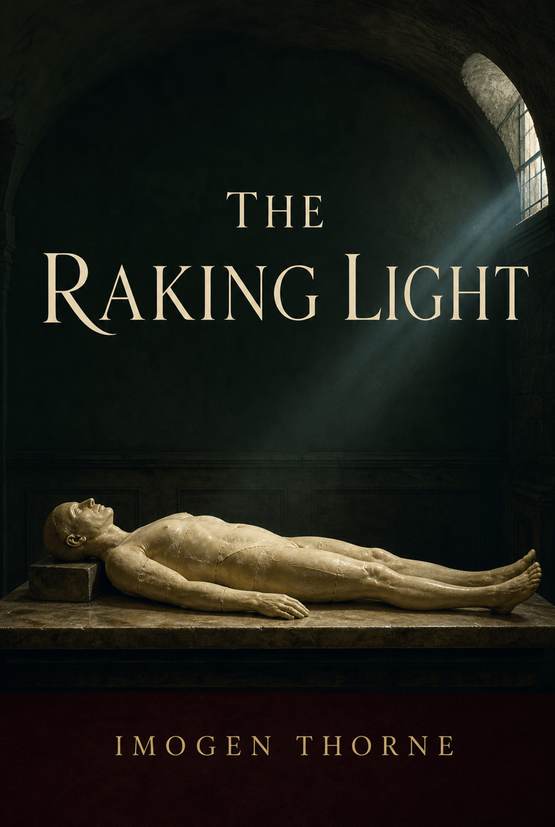
Chapter 1: Ninety Minutes on Arthur Pell
I had two fingers beneath Arthur Pell’s jaw and the point of a small spatula resting on the fold of his right eyelid when Nathaniel Miller said, ‘Thirteen hours.’ He gave the number to his cup. I gave the room a grandfather. ‘He taught me the lids first,’ I said. ‘My mother’s father, in Sacramento. He had a bench with this same lip along it.’ The lip was under my free thumb as I spoke, enamel over iron, chipped to a black crescent. I had never seen a craftsman’s bench before June. Arthur Pell’s eyelid received the blade without complaint, and the lie, entering beside it, was finer than the blade and left no visible mark.
The linen had been drawn down to the lower ribs. His chest bore the waxen yellow of a pear kept past supper; his sparse grey hair, combed away from the forehead for us, retained two damp furrows from the comb. A wooden block turned his face three degrees toward me. At that trifling inclination the left cheek yielded to gravity by less than the breadth of the spatula, but less was our province. The cold room at four degrees had already stiffened the tape around my first and second fingers. It had also put a faint glaze over the steel table, on which our sleeves drew temporary dark signatures and erased them at once.
Nathaniel stood beyond the crown of Pell’s head, warming his hands on the cup he never drank from. His wire glasses caught the ceiling tubes in two pallid bars. The other students occupied the farther benches with that accomplished stillness by which twenty-year-olds advertise that they’ve been admitted somewhere difficult; only Rebecca Davis moved, and she moved her fingers. She sat on the bench instead of the chair set beside it, bent each joint in order, and watched the tendon travel beneath the brown skin of her wrist. Her audit took forty-two seconds. I knew because she had made me time it once, then told me I was timing the wrong thing.
Before I touched Pell, Rebecca had made me learn him. Arthur Pell, sixty-eight, quarry-shed foreman in Weald Falls; dead at nine the previous evening in the valley hospital; two daughters, whose names she supplied before she supplied mine. He had been alive on Tuesday. That last fact, useless to medicine and indispensable to us, gave the face its recent grammar: the brow had finished frowning, the mouth had finished keeping its small leftward reservation, and neither could now be persuaded into a kinder sentence. The atelier required the maker to know the donor’s name before laying a finger on him. At the pour the name would be spoken aloud. A nameless figure had no right to stand two doors away, however exact its shoulders.
The other requirements had the clean cruelty of measurements. The forty-hour pour window began at death. Beyond it the tissues relinquished their own geometry by fractions—a softened ledge beneath an eye, a mouth settling farther than it had ever settled in sleep—and the mould, though faithful to what it met, would become the portrait of that delay. Then there were ninety minutes of fine control. Rebecca explained the span while winding tape around my fingers: after it, the maker’s hands continued to move, sometimes elegantly, but sensation had ceased to govern the elegance. The hand lied before the person chose to. This was offered as a technical observation, which is how the atelier concealed all its theology.
‘Orbital fold,’ Rebecca said.
I drew the spatula from the inner corner outward, taking the minute residue left by the hospital and nothing of the skin beneath. The blade was as broad as my little fingernail and flexible at its last quarter-inch. Too flat, it skated. Too upright, it printed its edge. I found the angle between those errors and cleared the lid until its folds could be read by plaster without the flattering blur of moisture. Then I followed the nasolabial crease, where a pale filament had lodged, and the shelf of the brow, where the flesh rose beneath my taped thumb with the dense, cool give of unworked clay. Clay, however, forgives rehearsal. Pell gave each movement back as a fact.
At twenty minutes Nathaniel called the hour remaining. At thirty he stopped. His silence had gradations I was already vain enough to hear. It began as supervision, narrowed to attention, and became, after I cleaned the shallow notch beside Pell’s nostril in one pass, an absence of correction. Rebecca continued to name surfaces. I continued to take them. The room’s compressor woke below the floor with a heavy internal knock and sent a tremor through the water in the rinse bowl. My blade stayed clear of the skin.
Gifts usually diminish under witnesses. Mine improved. I had been four months into the atelier, a probationer in all but title, and had spent those months arranging my cuffs, my clauses, and my fictive relations so that no one might notice the cheapness of their author. Over Arthur Pell, none of that arrangement helped me. My hands were either exact or they weren’t. At the brow they were exact; at the crease beside the mouth, exact again; beneath the jaw, where the skin thinned and a careless wrist could impose its own curve, better than exact, because I followed a structure I couldn’t yet feel and arrived where it was. Whatever else I had counterfeited, the blade kept producing evidence for me.
By minute forty the last eighth of an inch of my fingers had gone mute. The sensation vanished first beneath the nails, then retreated to the middle joints, leaving behind a pressure without locality. I shifted the work into my wrist. Moisture darkened the tape, loosened it, and turned the overlapping ends into little tongues. Rebecca stripped the first winding off, dropped it into the enamel tray, and retaped me while I held my arm extended above Pell’s shoulder. She did it again twelve minutes later. On the second occasion the tape came away wet enough to cling to her knuckle. She pinched it loose and gave me the blade.
‘Three minutes if you keep pretending the thumb works,’ she said.
‘Four,’ I said.
‘Three.’
I used two and a half. The spatula traveled from the outer eye toward the temple in strokes shorter than a grain of rice. With no report from the fingertips, the steel announced itself through the radius: drag, release, drag, the minute percussion climbing the bone to my elbow. I could see what I had removed only when Rebecca tilted the shaded work lamp and the surface changed from dull to satin. Nathaniel set his cup down without a sound. Someone behind me adjusted a stool and then thought better of sitting. The scrutiny I had courted all summer left my face for my hands. I was allowed, briefly and almost indecently, to be as good as I was.
Rebecca watched three strokes at Pell’s left temple. ‘You’re holding it wrong.’
She addressed the blade. My thumb lay along its spine; hers, when she demonstrated in the air, rested against the shoulder and governed the flex. One grip was learned beside another worker. Mine could have been reconstructed from the plate in an old manual, and had been. Rebecca didn’t sharpen the fact into an accusation. She named it as she might have named a temperature and waited for the correction.
I kept my thumb where it was. ‘My grandfather done it that way at his bench in Sacr’mento. Said it kept the blade from skatin’ once your fingers went.’
No one answered. Pell’s temple waited beneath me, the soft triangular hollow perfectly capable of recording either version. I completed the stroke, cleaned the blade on gauze, and said, in the voice I generally wore, ‘What does the mould work cost?’
Rebecca looked at me then. Compliments bored her; questions about method made her suspicious; questions about cost had, apparently, never been put to her. She flexed the two fingers she had used on my tape. ‘Feeling, first. You lose the small temperatures. Plaster can be ready against one finger and dead against the next, and you’ll remember the difference after you can’t feel it.’
She picked a dry curl of tape from her sweater. ‘Then skin. Chilblains by November. Cracks by February. The cracks take plaster, so you open them again every time you wash. Four seasons and your hands wake up slower than you do.’ Her delivery remained flat, Baltimore intact in every vowel. ‘The mould costs the part nobody sees. If it comes off right, they praise the wax.’
I asked how long she had left. The question was impertinent, and sincere. Rebecca’s fingers resumed their sequence—first joint, second, thumb across the palm—while she considered the bench between us.
‘Long enough to finish Pell,’ she said. ‘Your grip is still wrong.’
I changed it. One could describe my question as kindness, and I often have. The less ornamental account is that I knew questions were doors, and by twenty I could select the one a person had been waiting beside. Yet her answer cost her four minutes and gave me no usable advantage at all. It sat between us with the rude solidity of Pell’s jaw. I had wanted the room to admire my attention; instead I had been entrusted with a fact whose chief property was that it could do nothing for me. Naturally, I treasured it.
The corrected grip hurt. It placed the blade’s resistance into a strip of muscle Rebecca had developed and I had not, and within six minutes my thumb shook against the shoulder. I lowered the elbow, shortened the pass, and worked the tremor out of the steel. At the corner of Pell’s mouth a transparent film had gathered in the crease. I lifted it whole. Beneath, the line preserved its asymmetry: deeper on his left, ending abruptly on the right. A charming maker might have balanced it without knowing he had done so. My blade followed the imbalance. Rebecca said nothing. Nathaniel’s cup remained on the bench.
Footsteps entered the stairwell at minute eighty-one. They came down with no haste and paused outside the door, a courtesy the room performed in reverse: the people within straightened before the visitor appeared. Edward Sawyer entered with his hands linked behind his back. He wore the charcoal suit he had worn in September, though September’s man had filled it. Now the collar stood away from his neck, and the cloth beneath each arm descended too cleanly, untroubled by flesh. In a room trained upon fractions of bodies, we accepted this as tailoring.
Edward touched nothing. He walked to the side of the table and turned his whole body toward me, granting the sort of attention from which young men manufacture destinies. His pale eyes moved from my grip to the strip I had cleared above Pell’s brow. I had prepared for his approval since June and had prepared, in consequence, several versions of modesty. He spared me all of them.
‘A figure is a claim about a real body,’ he said, ‘and the claim must be true. Down here we possess Ashgrove’s hundred and forty years of accounts: continuous, exact, and often unkind, because the valley has never owed us beauty and we have never had the right to collect it. Other rooms in this college will offer you membership in an idea. This is the only room worth belonging to, because the body can refuse us.’
He spoke slowly, balancing the clauses until truth sounded less like restraint than admission to a superior appetite. I received the proposition with the avid solemnity of a convert who has already begun pricing dispensations. Before his last word had settled, I was composing my answer: something about duty, about Sacramento, perhaps about the privilege of correction. I can still furnish the sentence. Its polish has survived better than most of the people who would have heard it.
‘Ninety,’ Rebecca said.
The spatula was halfway beneath the outer brow. I stopped. The blade’s flexible tip remained bowed against the surface for a fraction, then straightened as I lifted it and set it in the tray. My intended answer disappeared with so little resistance that I mistook the loss for discipline. Edward’s gaze went to the instrument, then returned to me. Nathaniel picked up his cup. No one praised the work. Praise would have reduced it to manners, and the atelier’s cruelties were never so ordinary.
Rebecca bent over Pell and inspected the interrupted stroke. She could have finished it in ten seconds. Instead she drew the linen to the clavicles, leaving the face exposed for the next session, and wrote the ending minute on the slate. My fingers, freed of the blade, curled toward the palm and stopped halfway. Sensation returned as separate bright points, each arriving with its own small temper. Pell lay surface-worked beneath the lamps, his left mouth still deeper than his right and the brow turned three degrees toward the empty place where I’d stood. Thirteen hours remained to him.
The release sheet waited above the cold-room landing. I went for it with the tape still on, flexing my fingers against the wool of my coat, and found Henry Huff at the bottom of the sublevel stairs. He had brought Arthur Pell down an hour before our session and had gone no farther than this spot; forty bodies had crossed his arms here while he stayed behind the door. He wore the green van coat, its shoulders stippled with plaster dust from somebody else’s work, and carried the Fenn Chapel smell with him: damp rubber, embalming soap, the ferrous warmth of an engine whose heater had broken. His large red hands wiped themselves on his thighs before he offered me the clipboard.
The form bore Pell’s name, the hospital hour, and Henry’s compact signature above the blank reserved for the receiving member. A carbon sheet, blue-black and glossy, showed at one corner. I touched the stair rail before taking the pen.
Henry looked at my taped fingers, then at my face. ‘Gregory Lang,’ he said in my own voice—low, leisurely, the vowels from four miles down the valley set back exactly where I had found them as a child. His laugh arrived before the joke and ran a beat beyond it.
That was all. He made no request, proposed no bargain, named no price. I supplied each part for him. ‘I’ll put in a word with Professor Sawyer,’ I said. ‘About letting you observe. He listens to me.’ Edward had addressed one paragraph to my work, and already I had converted it into influence.
Henry’s eyes moved once toward the door and back. He nodded, still smiling, and held the clipboard steady while I signed. I called this blackmail before I reached the top stair; twenty years on, I have used the word so faithfully that it arrives in memory ahead of Henry himself. The carbon is less cooperative. It records a driver delivering Arthur Pell, a member receiving him, and no demand between the two names. Within ninety seconds of hearing my childhood spoken aloud, I had paid a man who’d asked me for nothing.
Henry tucked the pink copy beneath the clip, wiped his palms on his trousers once more, and carried my promise up toward the loading bay. The door opened on the van’s wan interior light, closed, and left me below with the pen still in my hand and a whole night in which to maintain a story nobody had questioned.