
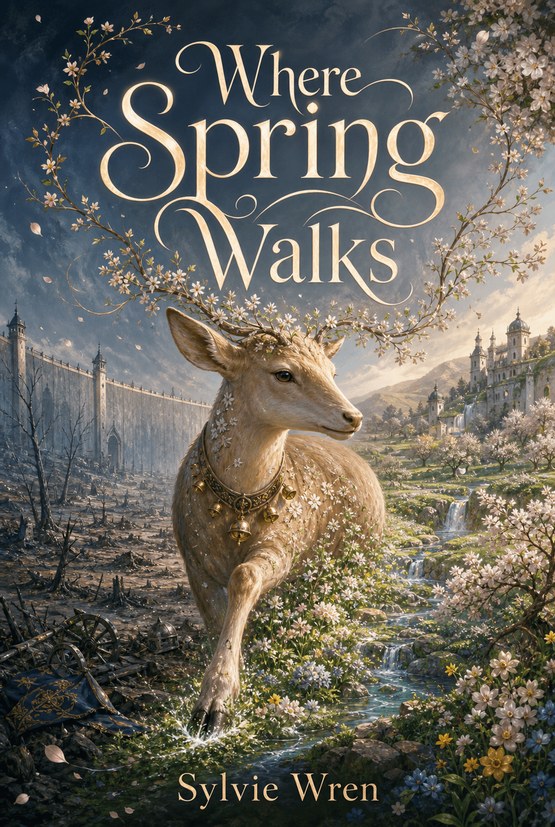
Chapter 1: Blood Under Snow
The doe had crossed our oldest boundary stone before dawn. I found the cleft print beside it, narrow and deep in the crusted snow, with one black hair caught on the lichen. The next print lay six feet on, then another six. A long stride for a winter-starved animal. I set two fingers between the slots, measured the spread, and looked down the orchard rows to where the land rose against the Wall. If I could come within thirty yards, the doe would feed us for weeks. If I missed, I had one sound broadhead left and no iron worth wasting on a running shape.
Snow had packed hard between the dormant pear trees. It took prints cleanly wherever the wind had scoured off the loose powder, and I moved from one to the next without touching the trail. The doe kept north along the irrigation cut instead of dropping toward the alder hollow, where browse and cover were better. Twice it stopped. The paired foreprints sank deeper; behind them, the hind feet had slewed outward. It had raised its head and listened toward the Wall. That was odd. Hunger made lesser oddities easy to dismiss.
I climbed the lower bank and tested the wind with a damp finger. Air came from the north, cold enough to ache behind my nails, carrying stone, old leaves, and no deer. The cut below me held a foot of grey ice. Fifty yards west, a plank bridge offered the nearest crossing. South lay the house, hidden by the orchard slope. North, the Wall stood beyond the last trees, its stones webbed with thorn. I counted the ways out because an exit found in haste was often an exit found too late.
The flour jar had given Nora seven more loaves if she mixed the dough meanly. Ellen had put barley water into the stew and called it broth only for Father's sake. Thomas could get from his bed to the stove with a stick, but the orchard slope defeated the leg the flood had broken. If I returned without meat, we would eat seed grain or trade one of the grafting knives before thaw. Either choice took food from a season that hadn't arrived.
The Orchard Axe lay across my back, steady between my shoulders. Its ash haft had darkened where three generations of Smith hands had held it. I carried it to clear storm limbs, split frozen roots, and cut a path home if the thorns came down under snow. My bow did the killing. The axe belonged to trees and work. There was comfort in keeping the uses of things plain.
A chip of ice clicked in the cut below. I crouched. The doe stood on the frozen channel thirty yards ahead, half hidden by a windfallen bough. She was small through the belly but tall at the shoulder, her winter coat the brown of wet bark. One forehoof rested on ice thin enough to show dark water beneath. It should have broken. Instead she leaned her weight onto it and turned her muzzle toward a knot of thorn at the Wall's foot. Her nostrils worked.
No wind came through the thorn. Nothing moved there. Even so, the doe listened with her whole body, ears forward and flanks held still. I looked for another animal, a hunter, a scrap of cloth on the stone. I found only the old irrigation bank, the family marker at my knee, and the ground I knew. The boundary stone bore my grandfather's cut pear branch. On this side, the orchard was ours. On the other, no hunger could make pursuit sensible.
I stepped across the marker and chose the lane between two bent pear trees. Their trunks screened my legs and left a clear opening above the cut. The doe moved off the ice. She passed the thorn seam, stopped once to nose the snow at its roots, then came south among the trees. I eased the last broadhead from my belt and nocked it. The feathers brushed my glove. I drew when her head went behind the nearer trunk.
She turned broadside. I set the point low behind her shoulder and released.
The strike sounded dull and close. The doe jumped, kicked once, and ran north. Red showed around the shaft before the trees took her. I lowered the bow and listened. A wounded deer spends itself in noise: brush breaking, hooves striking wood, then the lesser sounds that tell how far it has strength to go. This one crossed the next row and the next. A branch snapped near the upper bank. After that came silence. She had run too far for the blood I'd seen.
I waited the count of two hundred, though every lost minute cooled meat and brought scavengers. Then I slung the bow, loosened the Orchard Axe, and followed. Blood marked the snow in round bright drops. At the first row the drops stood a pace apart. At the second they joined in a thin red cast where her flank had brushed a sucker. The wound ran freely. The distance didn't agree with it.
Beyond the windfall, her tracks drove straight toward the Wall. She had passed cover, downhill ground, and the open lane back to the alder hollow. One hoof dragged now. Blood steamed in each print. Beneath the steam, the snow sagged and turned clear. I touched the wet edge with one knuckle. Warmth had entered the ground below.
The doe knelt at the thorn seam. Her forelegs had folded under her, but her hindquarters still strained to lift. Each effort forced the arrow against the stone and opened the wound. She struck her muzzle on the lower rocks, drew back, and struck again. There was no gap I could see, nothing beyond the woven briars but the Wall. Yet she drove toward it with the last order in her body.
I came from behind so she wouldn't spend herself fearing me. Her eye rolled once, black and wet. I put my knee above her shoulder, took the axe short on the haft, and set the bit below the skull. The Orchard Axe had belonged to trees and work. I gave it one other use.
Her body struck the ground. The tiny sound that followed came from beneath her, not from her: a soft tearing, repeated across the snow. Green points pierced the red slush around my boots. They opened into curled leaves while I watched. Crocus cups rose beside the arrow shaft, pale gold and purple, and small white flowers crowded the place where her throat had lain. The smell changed from iron and hide to wet soil warmed by sun. Winter held the orchard ten feet away. Within reach of my hand, spring worked without patience.
I stood and nearly slipped. Snow had softened to mud beneath both soles. Fine roots pressed through it and bound themselves around the doe's legs. I cut them back with the axe, more angry than frightened because anger could use a tool. Each severed root bled clear sap and put out two new green tips. Nothing touched the carcass itself. The growth kept to the spilled blood, feeding on the death and making it lovely. That was the worst of it.
A strip of bronze showed under the doe's neck. I cleared away the flowers and found a collar fitted close beneath her winter coat. It was warm. Not warmed by the body: the doe's ear had already cooled, while the metal held the mild heat of a stall at midday. Small bells had been worked all around it, each no larger than a hazelnut, with open mouths and bronze tongues. I lifted the band. None of them rang. From it came the close animal smell of many deer together, dung, milk, trampled grass, and rain drying on hides.
No poacher put such work on a wild doe. No farmer in Bramble End owned bronze to bury under fur. I slid the Orchard Axe under the collar and cut the leather lining. The bells stayed mute as the band came free. When I held it away from the body, every new leaf in the blood-dark soil turned toward the Wall.
The thorn moved.
It didn't shake in the wind. Stems thicker than my wrist drew apart, bending backward without snapping, and uncovered a slit of darkness between two stones. A man stepped through sideways with a blade in his hand. He wore a long green coat cut too fine for mud, dark at the hem from travel, and rings over his gloves. Black hair had come loose from its cord and lay against his cheek. He cleared the last thorn and went still.
His eyes passed over me, the axe, and the collar. Then he looked at the doe. The gold about his green pupils caught what little light the clouds gave. His blade lowered an inch.
“What have you done?” he asked.
I put the doe between us and kept the axe head low, where a raised weapon couldn't meet it before I moved. “Killed a deer on Smith land.”
He came one step nearer. The flowers reached to the polished edge of his boot. He looked down at them with a grief so calm I distrusted it. “You killed the lead Bell Doe.”
“I killed an animal that crossed my boundary.” The collar's heat seeped through my glove. “If the bells matter, you should have made them sound.”
His gaze lifted to me. The man had the composed face of someone accustomed to rooms falling quiet when he entered. Here there was only the dead doe, the wet work under my boots, and me. “They sound to the herd. Her scent holds them to the Spring Hart's road.”
“Which noun is the danger?” I asked. “The herd, the road, or this hart?”
“All three, now.” He sheathed neither his blade nor his answer. “I am Dylan Park, Lord of Spring. The Hart is near, and you have killed the guide that keeps it to the established corridor.”
“Lord Park,” I said, because a title was useful when one needed to know exactly whose arrogance stood in front of her. “I see blood, torn ground, and flowers eating through snow. Tell me what you see.”
His brow tightened. He looked around the doe. “Anemones. Celandine. Early iris. The ground is whole beneath them.”
I drove the axe bit into the mud and levered up a mat of new roots. Under it, the irrigation bank had split. Stones I had set in autumn lay crushed into the channel, and water seeped through the break beneath the ice. “Whole ground doesn't leak.”
He stared at the lifted earth. The flowers remained mirrored in his eyes even when I held a broken bank stone before him. He touched it with two gloved fingers. His stillness changed then. It had been rank before, a habit of making others wait. Now he held himself quiet to understand a fact that had injured him.
“The False Bloom,” he said. “I knew it concealed old damage north of the Wall. I didn't know it crossed here.”
“That name improves nothing.” I dropped the stone. “Show me what the doe's death changed.”
“You will come with me.”
The blade rose until its point faced the hollow below my ribs. He made the motion cleanly, without flourish. That frightened me more than shouting would have. I pulled the axe free and set my left foot behind the doe's haunch, where he would have to step over the carcass or circle through the mud. “You've named an order.”
“The Spring Hart can't be called back or commanded. It follows the Bell Does by scent, and the lead doe laid the line. Without her, it may turn anywhere the ground admits it.” His voice stayed measured. A strain showed only in the hand around the hilt. “If it leaves the corridor, Spring Court loses the passage that feeds it. Your fields may suffer as greatly as mine.”
“May.”
A tremor passed through the axe haft. The bronze collar answered against my wrist, not with a bell but with the faint clash of metal pieces touching. Snow fell from the nearest pear branch. Farther up the orchard, the frozen cut gave a low crack.
Dylan turned toward the rise. “It has already turned.”
I didn't follow him because he told me to. I went because the tremor had traveled through roots I knew, and because the split bank would send thaw water toward our lower rows if the break widened. We climbed beyond the last pear trees, keeping three paces between us. His blade remained drawn. I carried the axe in my right hand and the collar in my left. Behind us, the doe lay amid flowers that had no business knowing her blood.
At the top of the rise the snow stopped in a clean arc. The hollow beyond lay white and untouched except for one depression. It spanned the ground from the orchard's upper ditch to the base of the Wall. I could have laid the press-house floor inside it and had earth left around the boards. The forward rim had crushed three drainage stones and peeled the roots from a hawthorn. Fresh flowers crowded the break.
Warm rain fell into the print. I held out my bare wrist. The air above us stayed dry. Within the vast hollow, drops struck dark water and raised a light mist. The print filled from no cloud I could see. Its deepest point lay at the northern edge, but the broken stones showed a drag to the west. Whatever had made it had come down the old line, paused, and changed direction after the doe's flight failed.
Dylan stepped to the rim. “It went north.”
“The flowers went north.” I pointed with the axe. “The bank broke west. That root was pulled from the east face, and the mud has rolled over itself there. Your Hart turned toward Bramble End.”
He looked where I pointed. Gold petals drifted across his eyes. “I see a field in bloom.”
“I see what it broke.”
Another impact passed under us, stronger than the first. Water jumped in the great print. From beyond the next rise came a hoof-fall too deep to belong to any beast I knew, followed after four slow counts by another. The sound traveled west. Toward the clustered roofs below the orchard. Toward Father, Nora, and Ellen, who would hear only winter shifting in the ground until it reached them.
Dylan faced me again and lifted his blade. “You can read its course. You will cross the Wall and repair what you have broken before it reaches settled land.”
I closed my hand around the Bell Doe Collar. Its heat carried the smell of the absent herd. The doe couldn't be restored to it. The split bank, the westward turn, and the thing walking under the earth were mine to answer for. My body wasn't.
“You've named a need,” I said. “You haven't offered terms.”
A horn called beyond the thorn seam. A second answered, nearer. Through the narrow breach came the red shake of torchlight and the iron beat of mounted hooves. Dylan's sword stayed between us while, behind him, the thorns began to open wider.