
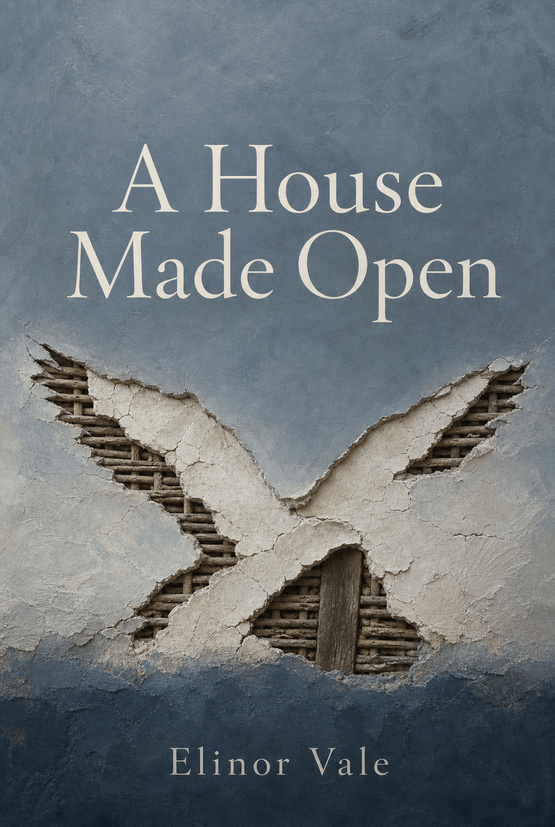
Chapter 1: The Hawk Errand
Mark lies beneath the unfinished Pageant Shutters with one cheek to the rushes, choosing his weapon. Morning has packed Hicks House full: Rother Market bawls through the open front, wet lime bites the back of Kristen’s tongue, and Jaime’s blue paint gives off its costly oil-sweetness from the trestles. Among the curls dropped by his father’s plane, Mark selects one pale and tight enough to spring. He cups it in both hands. The scrape on his chin goes solemn with purpose. Kristen has the Plaster Hawk on her palm and a knife through the lime when he rolls, quick as spilled peas, toward Krystal’s skirts. Krystal is measuring meal with the first joint of one finger. She has one shoe half off because a pebble troubles her, which is invitation enough for a brother. Mark tucks the curl into the heel and sits back on his haunches. His cut-down apron drags between his knees. Kristen watches the whole wicked business and says nothing. A child who is always told to be useful must steal foolishness where he can.
Krystal puts her foot down. The curl opens. “There is a tree growing in my shoe.”
Mark considers this with the gravity of a magistrate. “Water it after dinner.”
“I’ll water you now.” She catches his ear, but loosely; he twists free laughing, the wood curl caught in her fingers. “Mam, he’s spoiling Father’s London.”
At his bench Jaime rubs a blue shaving between thumb and forefinger. The Pageant Shutters rise behind him in hinged sections, painted clouds on one face and raw oak ribs on the other, a little weather waiting for the Swan Company to pay it into motion. “London has endured worse workmanship.”
“From you?” Mark asks.
Jaime smiles because Mark expects it. “Chiefly.” Kristen turns before the boy can make his escape and lays the haft of the Plaster Hawk across his forearm. The board is old, square, and stained in all the colors lime becomes after years of sweat: pearl at the edges, smoke gray under the grip, brown where Jaime once set it too near a kettle. Mark’s laughter closes. He brings his other hand under the board, then removes it when he remembers how Kristen carries it.
“Mistress Bell wants it at the bakehouse,” Kristen says. “Empty, mind. Both hands on the door latch. Set it on her table, away from the oven mouth, and come straight home.”
“I can bear lime on it.”
“You can bear the hawk.”
“Which weighs less than my honor.”
Krystal shakes the wood curl at him. “Your honor fits in a shoe.”
He holds the board level while she plucks the curl from his hair. Kristen’s palm remembers his weight as a baby before her mind summons it, the compact heat laid along her forearm, the fierce rooting mouth; then he is ten and narrow-shouldered, soot at one cuff, balancing a waller’s tool with his cheek bitten inward. Pride lifts his chest by a thumb’s width. She wants to correct his wrist. She lets it be. The neighboring door stands beyond their front, scarcely twelve paces through the market crowd, but Kristen stops Mark before he crosses the Hicks House threshold. “Come here first.”
The shared bay at the rear looks sound to anyone who values a wall by its whiteness. Two oak posts climb into the upper dim; a rail crosses between them, and limewash covers the hazel lath and daub fitted into the spaces. Yet one patch under the rail has cured the wrong color, milk laid over old cheese. Kristen found it three mornings ago while carrying the hawk past, and each morning since then her fingers have returned to it. She presses them flat now. Coolness gathers under the pad of her middle finger. Mark edges the hawk onto his left arm and sets his right hand where hers has been. “It breathes.”
“A wall has no lungs.”
“Then it steals ours.”
There he is: frightened by a draft and courting it in the same sentence. Kristen guides one finger to the lower rim of the patch. Air needles the sweat there, faint and sour with yesterday’s oven smoke. Somewhere beneath the lime skin, space remains. “Is it still a hole?” he asks.
“A mouse-wide one, maybe. Wide enough.” She taps the patched field, then the intact daub beside it. Two panels, held within the same post and rail. “Listen. One infill panel in a frame bay may stand open; any unclosed aperture makes its panel count as standing open. This patch has a mouth in it, so we count this panel open until I strip it, mend it through, and let it cure.”
He touches the neighboring panel. “And this?”
“Stays whole.”
“Even though the other hole is only mouse-wide?”
“A mouse needs no door. Weight needs no great hole.” Kristen puts his palm against the rail above both panels. Market carts jar the frontage; the timber gives back a minute, crowded trembling, old loads passing from joint to joint. “Open the one beside it and the rail can turn. Then the post above chooses where to fall, and no hand chooses with it.”
Mark studies the two white fields. One eyelid creases deeper, his mark of doubt. “Does the wall know which is beside?”
“The wall knows nothing. Timber obeys weight.”
“That sounds worse.”
“It is kinder than a lie.” She scrapes dried lime from her thumbnail. “What counts?”
“Any hole counts the whole panel open.”
“And the next panel?”
“Stays whole.” He squares the Plaster Hawk upon his arm again. “Unless the mouse learns walling.”
Kristen cuffs the back of his wool cap, and he grins up at her before slipping toward the market. Krystal calls after him to bring her honor back if he finds it. He passes between a basket of eels and a woman selling green onions, lifting the hawk above a swinging goose. Across the twelve paces, the Rother Bakehouse door swallows him into flour heat. For one instant the board rides above the heads inside, steady on his arm, then the door swings inward and he is gone. Ordinary absence. Kristen bends to the patch and inserts the point of her knife beneath a blister of limewash. Behind her, Jaime’s plane resumes its long wooden note. Krystal counts meal into a crock, humming half a market song and denying it the end. The row carries separate signs over separate doors—bread, painted work, leather, ale—while under the plaster its crooked frames lean on old favors no landlord has entered in an account. Heat comes through where it pleases. Drain water travels under thresholds. A hammer in the seventh house troubles cups in the first. The market fronts pretend independence because rent pays them to. Kristen lifts a curl of lime no larger than Mark’s thumbnail. Beneath it, the old coat powders instead of holding. Her mother would have called that color hungry. Never trust hungry plaster; it has eaten either too much wet or too little binding, and it will take more before it gives anything back. Kristen wets a fingertip, touches the powder, tastes the faint chalk at the corner of her mouth. Not today. She needs the bakehouse side cleared before she opens even the skin of the patch, and Mistress Bell is using that wall table. Mark will bring word when the table is free. A burst of laughter crosses from the bakehouse, his among it. Kristen recognizes the upward break at the end, the sound of him pretending surprise at his own joke. Then his voice, muffled by daub: “Seven, eight, nine—does the crooked one count?” He is numbering oven pegs. Mistress Bell answers too low to catch. A peel thumps. Bread crust scorches sweetly enough to soften the lime in Kristen’s mouth. The next sound is a pan striking floorstone. No one laughs after it. A woman calls a name once, then again with all the room emptied out of her voice. Feet drag. Something heavy meets the bakehouse table, and Kristen’s Plaster Hawk claps flat against wood. She is moving before Jaime’s plane stops. The market throws shoulders against her, hot wool and onion stalks, a butcher’s bloody apron. She reaches the neighboring step as Mark appears inside the bakehouse doorway, one hand on the latch as instructed. Flour whitens his hair. Behind him a journeyman lies folded beside the oven, his face dark with heat, his legs kicking weakly against scattered loaves. Mistress Bell kneels but holds her hands above him, afraid to touch. At the fallen man’s jaw, a swelling pushes the skin taut.
“Mam,” Mark says. His rapid speech makes each fact unnaturally neat. “Tom fell. He was cold first, though the oven is hot. Now he burns. Mistress Bell says fetch help.”
Kristen puts her foot on the sill. “Come behind me.” A dark sleeve crosses the opening. Shawn plants his body in the threshold, square shoulder against the door leaf, his clean coat collecting flour from the jamb. The Bridge Ward Watch follows him out of the market: two men with hammers, a coil of cord, a ward board, and the long black Watch Nails that every household knows by sound before sight. Shawn’s pale eyes pass from the swelling at the journeyman’s jaw to Mark, then settle on Kristen. “Out,” she says to her son.
Shawn catches the door before Mark can lift the latch. “No crossing now.”
“He crossed before the man fell.”
“Before the man fell.” Shawn repeats her last words as though testing rotten wood. “And stood in the room after.” Mark squeezes sideways. Kristen reaches between Shawn and the jamb, near enough to catch the boy’s apron tie. Shawn drives his hip into the door. The narrowing gap scrapes Kristen’s knuckles, takes Mark from a face to one hazel-green eye, then to flour-darkness. “Forty days from today,” Shawn says. “Bakehouse keeps bakehouse sickness.”
“He is my child.”
“Which changes neither fever nor count.” He looks over her shoulder. “Set the ward mark. Forty cuts. Score this day.” One watchman braces a narrow tally board beside the street door and scratches the marks into it, eight groups of five, pale wounds in dark oak. He scores the first across. Thirty-nine stand untouched beneath his knife. The other man lays a Watch Nail to the door plank.
Kristen puts both hands against the wood. “Mark, move from the door.”
“I’m back.” His voice comes thin through oak.
The first hammer blow punches the plank into her palms. A second drives iron through door and jamb. Market noise stumbles around it: sellers quieting, buyers drawing their skirts close, a horse clattering on because a horse recognizes no ward order. At the third nail Jaime comes out of Hicks House with blue paint across two fingers. He looks at his father, then at the sealed door, searching sightlines where none remain. “He is in there?”
Kristen strikes the door with the heel of her hand. “Mark.”
“Here.”
His voice answers below the latch. Relief is useless. She takes it anyway. “Stay by the door.”
Inside, Mistress Bell orders the children and the youngest apprentice into the flour loft. A child begins crying. Mark says he won’t go up alone. Kristen hears the argument travel away from the street front—the mistress insisting, Mark’s soft voice turning solemn, another woman pleading for someone to hold Tom’s legs. Then Mark calls through the door, “Mam, they’re scared of him.”
“Don’t touch his spit or cloth. Stay clear of the oven tools he touched.” She knows sickness can cross by routes no eye follows; she knows also that a frightened room can crush a fallen man before fever finishes its work. “Keep the little ones back.” Shawn signals the hammer again. Kristen rounds on him. Anger cleans every word. “Pull the nails. I take only Mark.”
“Open this door and every threshold he crosses takes the same count. Hicks, your wanting does no arithmetic.”
“Nor does your coat make you master of my son.”
“My watch. My row. My liability.” He plants one hand on the nailed planks, signet ring dull against the iron. “The forty-day quarantine stands. If the boy shows no fever, count that mercy and keep him from the sick man.”
The last Watch Nail sinks. Iron heads make a crooked constellation across the door. Beside them the tally board displays its single scored cut and the thirty-nine that remain. The market begins to move again by degrees, but it bends around the bakehouse frontage, leaving a bare crescent in the crowd. Shawn takes his place inside that emptiness. Kristen says Mark’s name once more. No answer comes from the street door. Then, from within Hicks House, three quick taps trouble the shared plaster. She runs. Krystal is already at the old patch, meal whitening both hands. Jaime follows hard enough to overturn his stool; behind him a Pageant Shutter rocks on its trestle, blue cloud flashing, raw ribs showing, blue again. Kristen reaches the wall and lays her palm flat. Heat from the bakehouse has warmed the daub around the patch, but the little draft remains cold.
“Mark.”
“I can hear you here.” His words arrive blurred yet unmistakable, each one combed by lath. “Near the place that steals breath. I counted from the oven pegs. Nine pegs to the corner, then the table, then your wall.”
“Where are the others?”
“Mistress Bell is with Tom. Joan has the little girls. Ned is crying though he says it’s flour. I said I’d stay till he stops.”
Of course he has made himself useful. Of course the praise they fed him has ripened at the worst hour. Kristen presses harder, wanting her hand to become narrow enough for every crack. “How long is forty days?” he asks.
Krystal turns her face aside. Jaime stands in the passage with his painted fingers spread, touching nothing. “Too long,” Kristen says. “Move closer to my voice. Keep everyone else behind you.”
She takes the scraper from her belt. The old patch gives under the first stroke with a soft mealiness. Lime flakes onto her knees. Another stroke exposes the wrong-woven hazel beneath, a lath end darkened by years of bakehouse damp. Her mother’s rule is alive in Kristen’s fingers, though her mother is not: never call covered closed, never call quiet sound, never ask a rail to forgive what a hand has chosen. Kristen scrapes around the cool point until a black slit appears. The scraper enters to its shoulder. Mouse-wide. Air streams through carrying scorched rye, sweat, and the frightened salt of bodies shut in heat. Kristen works the blade sideways. Loose daub spills from the far face, and Mark coughs once. The lath shifts under her thumb instead of resisting. No cured repair bridges the two sides. No hidden backing takes load. The first panel stands failed open exactly as she taught him to count it.
“You found it,” Mark says.
She withdraws the scraper. Through the aperture comes a child’s sob and Mistress Bell calling for water. Beneath Kristen’s palm the rail bears the patched field and the intact field beside it, one timber carrying both their demands. A market cart strikes a rut outside. The rail answers with a low complaint she feels in the heel of her hand. Nothing mystical in it. Wood, weight, weakness. Knowledge. From the front Shawn’s voice carries through the house. “The door remains nailed, Mistress Hicks.”
Jaime turns toward the market, then back to Kristen. He knows her tools by posture. His smile has vanished. “Tell me what holds.”
“Too little.” She points to the floor chest beneath the adjacent panel. “Move that. Krystal, clear the table and all bodies from this bay. Now.”
Krystal grips one chest handle. “Mam.”
“Now.”
Jaime takes the other handle, and together they drag the chest across the rushes. Kristen fetches a short shore from beside the stair, plants its foot, and knocks the head beneath the rail. Local support only. A prop under one span cannot restore the lath already loose beside it; cannot make one open panel into none. She tests the shore with both palms. It seats, but the rail’s trembling continues beyond it, a pulse carried under skin. “Mam?” Mark says through the slit. Behind him Ned is still crying. “The door has all those nails. Is there another way?”
There is always another way if the person naming the way is willing to spend what belongs to everyone. Her mother did not say that. Her mother kept the rule simple because timber cannot bargain with love. Kristen looks once toward the front. Shawn’s shoulder cuts across the market light beyond the passage, a man made into a lock by ownership and fear. The nailed door is his answer. The wall is hers, or she has believed her hands make it hers. She stops asking him. From the tool basket Kristen takes the chisel and her mallet. She sets the chisel against intact lime in the adjacent second panel, one handspan from the exposed aperture. The correct place for it is nowhere. Every point in that white field shares the bay. She places it anyway.
Jaime comes toward her at a run. “Kristen.”
The old aperture cools two fingers of her bracing hand. Above, the post carries the upper floor, Mark’s chamber, their bed, the ordinary stored weight of blankets and winter apples. Below, the shore crowds the rail but cannot absolve it. She knows each burden by touch. Expertise offers no permission. It only removes surprise. “Mark, come toward my voice,” she says.
His answer is close enough to stir flour and old lime through the slit. “I’m here.”
Kristen raises the mallet. Krystal catches Jaime’s sleeve as he reaches the bay. Shawn calls from the street. The rail presses its warning into Kristen’s palm, first panel open, second panel whole, one choice remaining whole with it. She strikes. The chisel jumps. Intact lime cracks around the iron, and the first piece of daub breaks inward toward the Rother Bakehouse.